 Daily Earth View
What Is the L1 Lagrange Point?
•
Unlock the secrets of the L1 Lagrange Point, the cosmic sweet spot that enables NASA's DSCOVR spacecraft and EPIC camera to provide uninterrupted views of Earth from 1 million miles away. This special orbital location is key to the daily full-disk images on DailyEarthView.com, allowing us to watch our planet's sunlit side in continuous motion. Let's delve into what makes L1 so unique and why it's perfect for Earth observation.
Understanding Lagrange Points
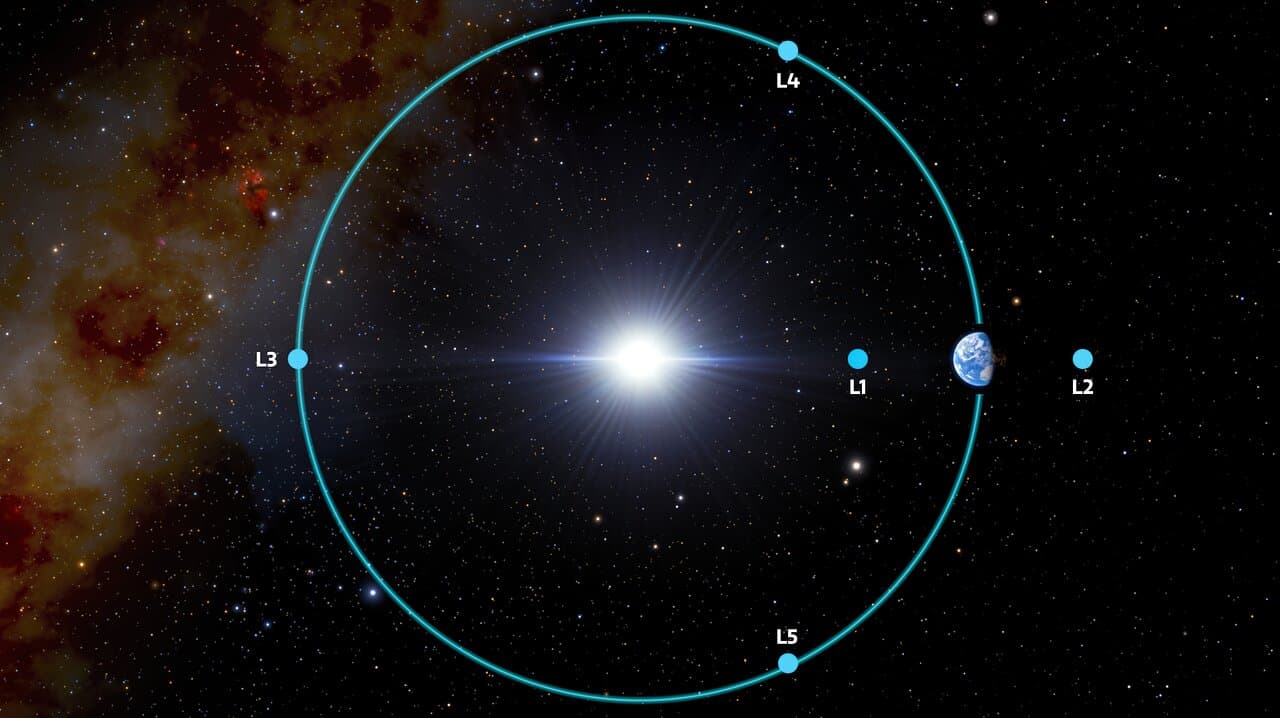
Lagrange points are positions in space where the gravitational forces of two large bodies—like the Sun and Earth—balance with the centripetal force required for a smaller object (e.g., a spacecraft) to maintain a stable orbit relative to them. Named after mathematician Joseph-Louis Lagrange, who predicted them in 1772, there are five such points (L1 through L5) in any two-body system.
These points arise from the restricted three-body problem in celestial mechanics, where the smaller object's mass is negligible. L1, L2, and L3 are along the line connecting the two main bodies, while L4 and L5 form equilateral triangles with them, offering greater stability.
Focus on the L1 Point
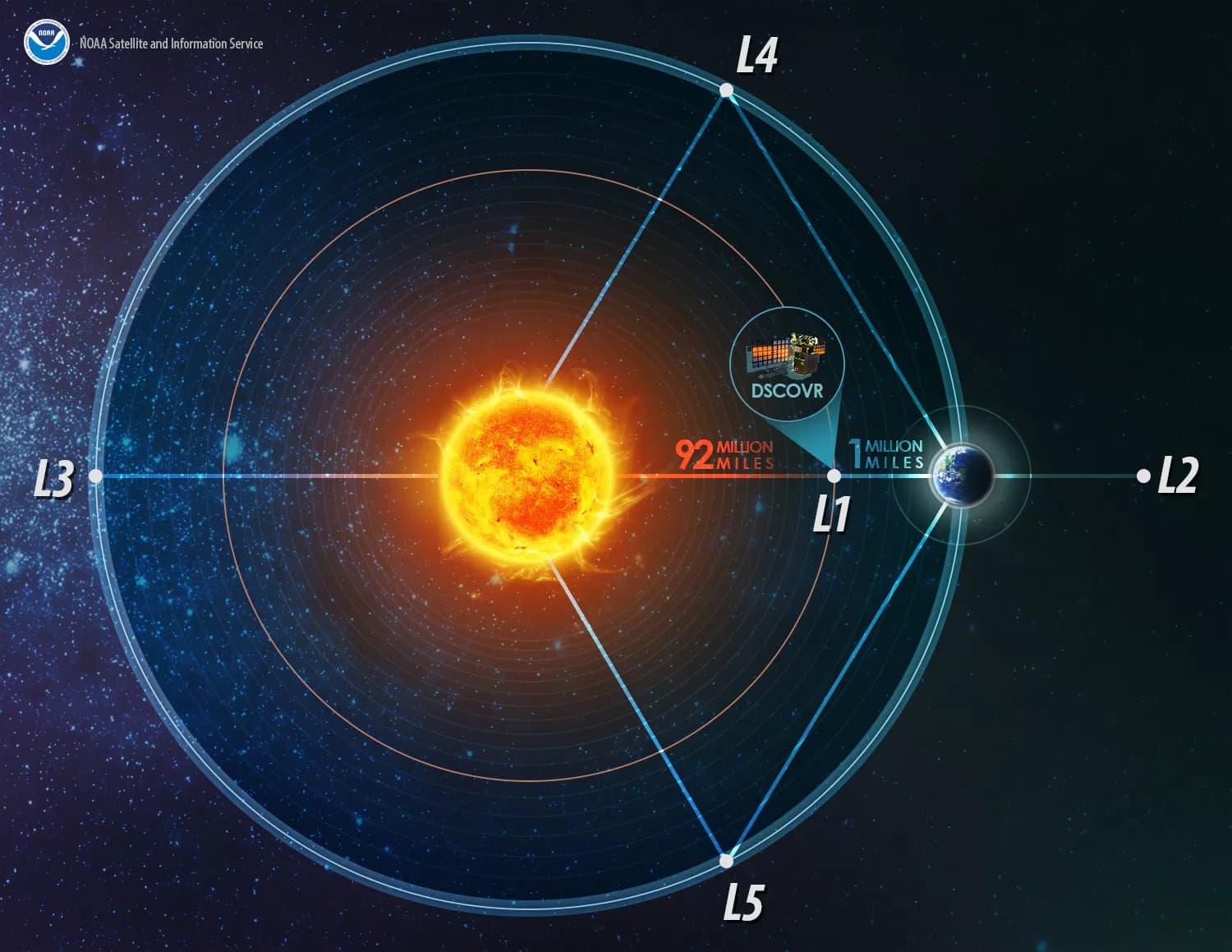
The L1 Lagrange point in the Earth-Sun system lies about 1 million miles (1.5 million kilometers) from Earth, toward the Sun—roughly 1% of the distance between Earth and the Sun (93 million miles). At L1, the pull from the Sun is slightly stronger, but Earth's gravity counters it just enough to keep a spacecraft in a quasi-stable "halo" or Lissajous orbit around the point.
This position isn't perfectly stable (unlike L4 and L5); small perturbations require occasional thruster adjustments to maintain orbit. For DSCOVR, launched in 2015, this means orbiting L1 in a pattern that keeps Earth centered in EPIC's view, with the planet appearing to vary slightly in size (0.45 to 0.53 degrees) over a 6-month cycle. This enables the stunning views of Earth from 1 million miles away and the clear observation of daily rotation.
How L1 Enables Continuous Earth Observation
L1's magic lies in its alignment: It's sunward of Earth, providing a perpetual view of the planet's fully illuminated side without eclipses or orbital interruptions. From here, EPIC captures the entire sunlit hemisphere—impossible from low-Earth or geostationary orbits.
- Constant Illumination: The Sun is always "behind" the spacecraft, lighting Earth like a spotlight.
- Early Warning Potential: L1 also monitors solar wind (via DSCOVR's plasma sensors), giving 15-60 minutes' advance notice of space weather events.
- Data Transmission: The position allows efficient communication back to Earth, beaming images and measurements for our daily updates on DailyEarthView.com.
This setup is why you can slide through 10-13 timestamps each day and see seamless planetary rotation and cloud shifts.
Scientific Benefits and Other Missions
Beyond EPIC, L1 supports solar and space weather research. Missions like SOHO (Solar and Heliospheric Observatory) and ACE (Advanced Composition Explorer) also occupy halo orbits here, studying the Sun's corona and particle emissions. The data collected from L1 powers the science of satellite imagery and enables the precise measurements of Earth's vital signs.
The point's utility extends to future endeavors, like potential telescopes or relay stations, leveraging its gravitational equilibrium for fuel-efficient, long-term operations.
Fun Facts and Why It Matters
- Discovery Milestone: The first Lagrange point satellite was SOHO in 1995; DSCOVR joined in 2015, building over a decade of Earth data.
- Cosmic Parking Spots: L1 is like a gravitational "hilltop"—objects can roll away, but with minimal fuel, they stay put for years.
- Broader Applications: In other systems, like Jupiter's, Lagrange points host Trojan asteroids, hinting at their role in solar system formation.
Explore Further
The L1 point transforms space observation, making DailyEarthView.com's archive a living record of Earth's changes. Check out today's view on the homepage or explore historical data in our archive. For more insights, return to the Learn section and discover topics like EPIC's technology or cloud dynamics.
All details sourced from NASA's missions. For in-depth info, visit NASA's EPIC page.